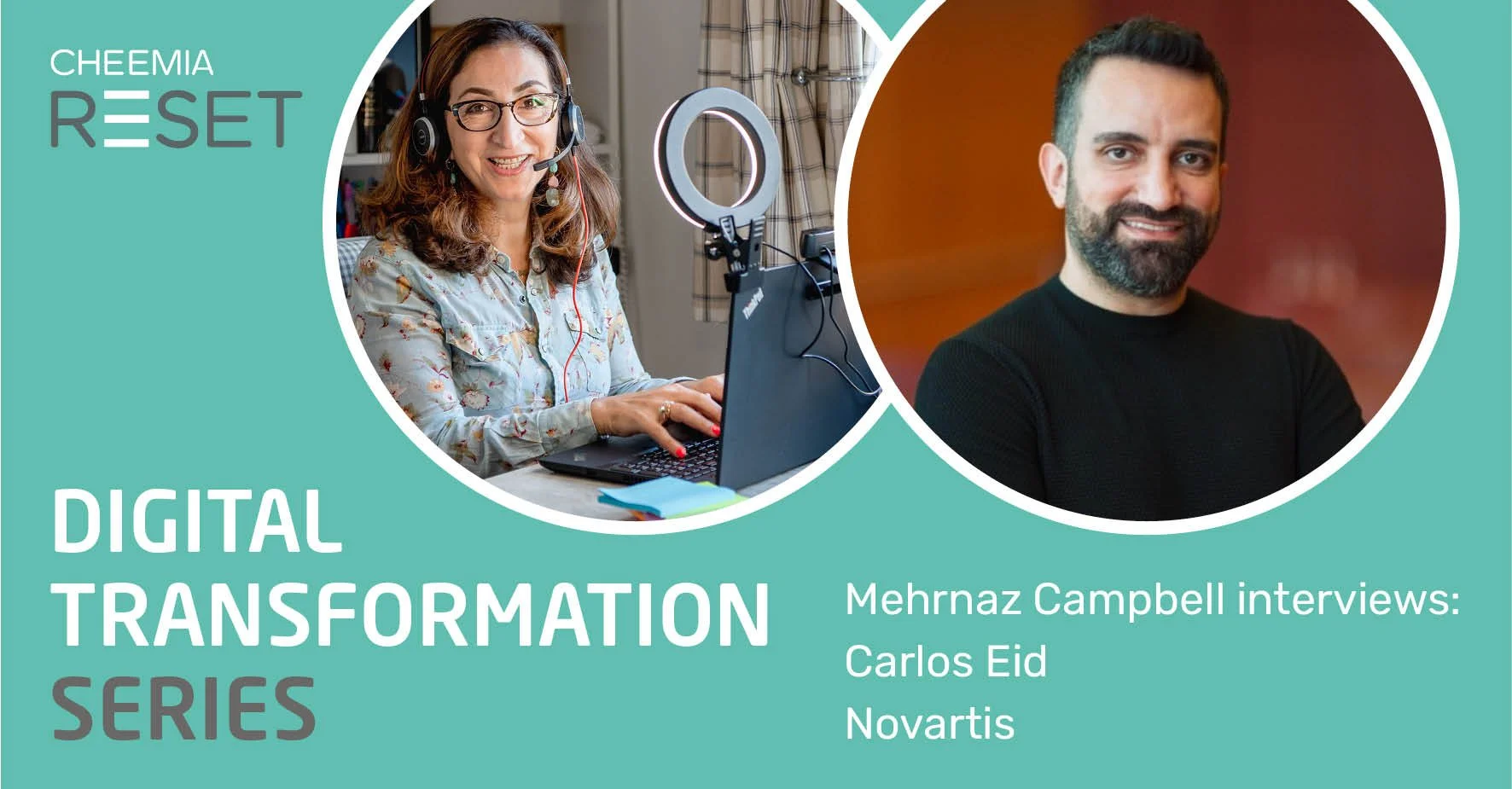
DIGITAL TRANSFORMATION SERIES - The MSL role should focus on problem-solving
My passion is about inspiring pharma leaders to shift from just delivering messages to healthcare professionals to transforming and becoming their trusted advisers. Over the past three years, we’ve tackled the challenges of digital transformation in healthcare, and through these LinkedIn conversations, I want to spark connection, inspire change, and drive meaningful transformation that improves outcomes for healthcare professionals and their patients.
I was delighted to interview Carlos Eid, Executive Director, International Medical Affairs Cardiovascular with Novartis in June.
Introduction
Carlos is a medical director, a global pharmaceutical professional with over fourteen years of experience spanning medical affairs, market access and field medical excellence. He currently leads the cardiovascular medical affairs team for international markets, where he applies his expertise across diverse geographies. He is driven by the opportunity to make a meaningful impact on clinical practice and patient outcomes.
In his personal time, he enjoys writing and speaking with other leaders, and he likes to talk about leadership, field medical and the future of medical affairs. He’s a huge Lego fan, a musician and a father of two girls. We first met in-person on a panel at the NEXT Pharma Summit in Vienna.
Disclaimer: Carlos is representing his own views here, not his company.
Why did you choose the pharma industry? Can you tell us a little about your career path?
I come from a small country - Lebanon. When I finished medical school and was working in the medical field, I started learning more about the pharma industry and what they do in terms of research, education and partnerships. I found this as an opportunity to expand my reach and expand the impact I could have the job I want to do for years to come. I felt that I could leave a bigger footprint in the world through my career move.
Being a doctor, of course, you can have a very good footprint - but I felt I wanted to go outside my own clinic and really have an impact on a more diverse population and geography. With pharma, I found that this is where science meets business. That’s the path I took, and I’ve had a great career.
Are you seeing any use of AI in the cardiovascular space and medical affairs in general? What are your observations and comments?
Look, it’s a super-hot topic. Everyone is mentioning AI in one way or another. You go on LinkedIn and most content is AI-generated. You see AI images, you go to work, they’re upskilling you on AI, AI this, AI that.
Now, if I want to frame it: it’s not just hype; the future will be powered by AI, and humans will work with AI. But we’re not yet at the stage where AI can truly do complex reasoning. We’ve seen the Apple study and other publications showing that reasoning skills aren’t fully there with AI.
In our space, though, AI is making real advances:
In drug development: Selecting certain targets, molecules, or pathways. It won’t invent new pathways because it learns only from the data you feed it, so it won’t discover a brand-new receptor no one has seen before. But it speeds up development and trials.
In medical affairs; we see AI in HCP segmentation, interest mapping, and content creation, though the latter is not heavily used yet due to hallucination risks.
In Med Info and insights analysis, AI has been there for a while, and now with GenAI, it’s becoming more advanced. Previously, it highlighted trends; now, you can prompt it for insights summaries across countries or by topic.
In daily work, AI can review articles, LinkedIn posts, grammar, or create images quickly, avoiding the hassle of purchasing stock photos. It elevates content quality and speeds up processes.
But here’s my caution. Don’t become dumb. People fully relying on AI for everything risk losing their critical thinking. Studies show cognitive function can decline if you stop using your brain for simple tasks. Before smartphones, we memorised 50+ phone numbers; now, we can barely remember our own because we rely on devices.
AI should assist you, not replace your thinking.
Can you provide a successful case study with AI in medical affairs at Novartis?
I’m here representing my own views, not my company’s. What I can share (without sensitive business details) is our work using AI in insights.
We used AI to generate meaningful, actionable insights by removing human bias in input selection from countries. AI analysed large data volumes, highlighted trends and emerging topics, and allowed us to see if a trending topic we equipped the field to discuss was increasing or decreasing over time. We also identified a key research area based on similar insights emerging from two geographically distant countries, indicating a potential study area for our drugs. This is just one example of AI providing value in insights generation.
Have you seen examples of AI helping HCPs identify suboptimally managed patients, like an audit tool?
There are discussions in various countries and pharma companies around incorporating AI into electronic health records to support early patient identification for preventive care. For example, Stanford uses AI to identify patients at risk earlier based on family history, blood tests and baseline characteristics, enabling early interventions that benefit patients, the healthcare system, and cost efficiency.
You can look up Stanford’s AI in cardiology on Coursera; it’s discussed there. It would be interesting to see more in the public domain on this.
Are heavy regulations making it hard to trust AI without validation?
Absolutely. But “regulated” doesn’t mean impossible - it means we need to bring compliance, legal, IT and cross-functional stakeholders into the journey from the start, with a clear problem to solve.
For example, using AI in medical information chatbots can be done safely by feeding them only approved content to reduce risk. It’s about identifying the patient or HCP benefit first, then building compliant solutions, rather than implementing AI for the sake of using AI.
And let’s be clear: HCPs don’t care if it’s AI or human help; they care about solutions to their problems. If education is the problem, data-sharing is good. If access is the problem, collaborate with access teams to solve it. The MSL role should focus on problem-solving, not just data dissemination.
What are your thoughts on the field medical function losing access to HCPs if HCPs can use AI to gather insights themselves?
This is a critical point. If MSLs are only used for data delivery and insight collection, the role will become obsolete. AI can give me a full summary of ASCO in seconds. The real value of an MSL is partnership and problem-solving. Helping with evidence generation, access challenges, clinical pathways, or new therapy education is where MSLs add value. If pharma doesn’t evolve the MSL role, it will disappear. Let’s bring it back to strategic problem-solving.
How do you measure the impact of digital transformation and omnichannel?
First, identify the actual problem you’re trying to solve with digital transformation. Often, we jump to “omnichannel” without a clear purpose, ending up with a multi-channel push that HCPs don’t need or want.
HCPs prefer non-biased platforms and credible information, often outside pharma websites, which they may see as biased. We must think beyond pushing content and understand what continuous value delivery means to them.
Second, don’t pilot endlessly. Pick 1-3 key markets, implement, iterate fast and refine. Long pilots delay progress, and by the time you’re ready to implement, better tools may already exist. Move fast and be brave.
Activity without value is just noise. Impact requires relevant, contextual and actionable engagements.
Conclusion
If you take one message from this blog: It’s not about channels; it’s about connection. It’s about listening, understanding and adding real value. Together, we can bring meaningful change to patients, HCPs and ourselves.
If you would like to purchase a copy of The Omni Advantage, it is available as a paperback or audiobook.